Welcome to the website of Changzhou Songjie Electric Motor Co., Ltd!


2024-05-09 16:24:42
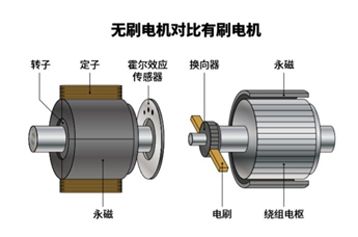
1、 The principle of brushed motorBrushed motors use mechanical commutation, with magnetic poles stationary and coils rotating. When the motor is working, the coil and commutator rotate, while the magnet and carbon brush do not rotate. The alternating change in the direction of the coil current is completed by the inverter and brush that rotate with the motor.In a brushed motor, this process involves arranging the two power input terminals of each group of coils in a ring, separating them with insulating material to form a cylindrical object that is connected to the motor shaft. The power supply is powered by two small carbon pillars (carbon brushes) made of carbon elements, which are pressed from two specific fixed positions on the circular cylinder of the coil power input under the action of spring pressure, to energize a group of coils.As the motor rotates, different coils or different poles of the same coil are energized at different times, creating a suitable angle difference between the N-S pole of the magnetic field generated by the coil and the N-S pole of the nearby permanent magnet stator. The magnetic fields attract each other and repel each other, generating force that drives the motor to rotate. The carbon electrode slides on the coil connector, like a brush brushing on the surface of an object, hence it is called a carbon "brush".Sliding against each other will cause friction on the carbon brush, resulting in wear and tear, requiring regular replacement of the carbon brush; Alternating on-off connections between carbon brushes and coil terminals can generate electrical sparks, electromagnetic waves, and interfere with electronic devices.2、 Working principle of brushless motorThe brushless motor adopts electronic commutation, with the coil stationary and the magnetic poles rotating. Brushless motor is a set of electronic devices that use Hall elements to sense the position of permanent magnet poles. Based on this perception, electronic circuits are used to timely switch the direction of current in the coil, ensuring the generation of magnetic force in the correct direction to drive the motor. Eliminating the drawbacks of brushed motors.These circuits are motor controllers. The controller of a brushless motor can also achieve some functions that cannot be achieved by a brushed motor, such as adjusting the power switching angle, braking the motor, reversing the motor, locking the motor, and using the brake signal to stop supplying power to the motor. The electronic alarm lock of electric bicycles now fully utilizes these functions.Brushless DC motor consists of a motor body and a driver, and is a typical electromechanical integrated product. Due to the self controlled operation of brushless DC motors, they do not require additional starting windings on the rotor like synchronous motors that start under heavy loads under variable frequency speed regulation, nor do they produce oscillations and loss of step during sudden load changes.3、 Differences in speed regulation methodsIn fact, the control of both types of motors is voltage regulation, but due to the electronic commutation used in brushless DC, digital control is required to achieve it, while brushed DC is controlled through carbon brush commutation using traditional analog circuits such as thyristors, which is relatively simple.1. The speed regulation process of a brushed motor is to adjust the voltage of the motor power supply. The adjusted voltage and current are converted through rectifiers and brushes to change the strength of the magnetic field generated by the electrodes, achieving the goal of changing the rotational speed. This process is called variable voltage speed regulation.2. The speed regulation process of a brushless motor involves keeping the voltage of the motor's power supply constant, changing the control signal of the electric regulator, and then adjusting the switching rate of the high-power MOS transistor through a microprocessor to achieve a change in speed. This process is called variable frequency speed regulation.4、 Performance differences1. Brushed motors have a simple structure, long development time, and mature technologyAs early as the 19th century, when the electric motor was born, the practical motor produced was the brushless form, namely the AC squirrel cage asynchronous motor. This type of motor has been widely used after the generation of AC power. However, asynchronous motors have many insurmountable defects, resulting in slow development of motor technology. Especially, brushless DC motors have been unable to be put into commercial operation. With the rapid development of electronic technology, DC motors have only gradually been put into commercial operation in recent years, and in essence, they still belong to the category of AC motors.Not long after the birth of brushless motors, people invented DC brushed motors. Due to the simple mechanism, easy production and processing, convenient maintenance, and easy control of DC brushed motors; DC motors also have fast response, large starting torque, and the ability to provide rated torque from zero speed to rated speed, so they have been widely used since their inception.2. DC brushed motor has fast response speed and high starting torqueDC brushed motors have fast starting response speed, high starting torque, smooth speed change, and almost no vibration when the speed ranges from zero to * * *. They can drive larger loads during starting. Brushless motors have high starting resistance (inductance), so the power factor is small, the starting torque is relatively small, there is a buzzing sound and strong vibration during starting, and the load driven during starting is small.3. DC brushed motor runs smoothly and has good starting and braking effectsBrushed motors are regulated by voltage and speed, so they start and brake smoothly, and also run smoothly at constant speed. Brushless motors are usually controlled by digital frequency conversion, which first converts AC to DC and then DC to AC, and controls the speed through frequency changes. Therefore, brushless motors operate unstably and vibrate greatly during starting and braking, and only stabilize when the speed is constant.4. DC brushed motor has high control accuracyDC brushed motors are usually used together with gearboxes and decoders to increase the output power of the motor and improve control accuracy. The control accuracy can reach 0.01 millimeters, allowing moving parts to stop almost anywhere they want. All precision machine tools use DC motors to control accuracy. Due to the instability during start-up and braking, the moving parts of a brushless motor will stop at different positions every time, and must be stopped at the desired position through positioning pins or limiters.5. DC brushed motors have low operating costs and are easy to maintain. Due to the simple structure, low production cost, multiple manufacturers, and mature technology of DC brushed motors, they are widely used in factories, machining machines, precision instruments, etc. If the motor fails, only the carbon brush needs to be replaced, and each carbon brush only costs a few yuan, which is very cheap. Brushless motor technology is immature, expensive, and has limited application scope. It should mainly be used in constant speed equipment, such as variable frequency air conditioners, refrigerators, etc. If the brushless motor is damaged, it can only be replaced.6. Brushless, low interferenceThe brushless motor removes the electric brush, and the direct change is that there is no electric spark generated during the operation of the brushed motor, which greatly reduces the interference of electric sparks on remote control radio equipment.7. Low noise, smooth operationBrushless motors without electric brushes greatly reduce friction during operation, resulting in smooth operation and much lower noise. This advantage is a huge support for the stability of model operation.8. Long lifespan, low maintenance costWithout electric brushes, the wear of brushless motors is mainly on the bearings. From a mechanical perspective, brushless motors are almost maintenance free motors, and when necessary, only some dust removal maintenance is needed.
Learn more
2024-05-09 16:24:40
The electrical equipment that converts electrical energy into mechanical energy is collectively referred to as a motor. Electric motors use the principle of electromagnetic induction to achieve the mutual conversion of electrical energy and mechanical energy. The device that converts mechanical energy into electrical energy is called a generator, while the device that converts electrical energy into mechanical energy is called an electric motor.Classification of motorsAccording to the type of working power supply, it can be divided into DC motors and AC motors.1) DC motors can be divided into brushless DC motors and brushed DC motors according to their structure and working principle.Brushed DC motors can be divided into permanent magnet DC motors and electromagnetic DC motors.Electromagnetic DC motors are divided into series excited DC motors, parallel excited DC motors, separately excited DC motors, and compound excited DC motors.Permanent magnet DC motors are divided into rare earth permanent magnet DC motors, ferrite permanent magnet DC motors, and aluminum nickel cobalt permanent magnet DC motors.2) AC motors can also be divided into single-phase motors and three-phase motors.According to their structure and working principle, they can be divided into DC motors, asynchronous motors, and synchronous motors.1) Synchronous motors can be divided into permanent magnet synchronous motors, reluctance synchronous motors, and hysteresis synchronous motors.2) Asynchronous motors can be divided into induction motors and AC commutator motors.Induction motors can be divided into three-phase asynchronous motors, single-phase asynchronous motors, and shielded pole asynchronous motors.AC commutator motors can be divided into single-phase series excited motors, AC/DC dual-purpose motors, and repulsion motors.Divided by starting and operating modes:Capacitor starting single-phase asynchronous motor, capacitor running single-phase asynchronous motor, capacitor starting running single-phase asynchronous motor, and phase separated single-phase asynchronous motor.Divided by purpose: drive motors and control motors.1) Electric motors for driving can be divided into: electric motors for power tools (including drilling, polishing, grinding, slotting, cutting, expanding, etc.), electric motors for household appliances (including washing machines, electric fans, refrigerators, air conditioners, recorders, video recorders, DVD players, vacuum cleaners, cameras, hair dryers, electric shavers, etc.), and electric motors for other general small mechanical equipment (including various small machine tools, small machinery, medical equipment, electronic instruments, etc.).2) Control motors are further divided into stepper motors and servo motors.According to the structure of the rotor, it can be divided into:Cage induction motors (formerly known as squirrel cage asynchronous motors) and wound rotor induction motors (formerly known as wound type asynchronous motors).There are a wide variety of electric motors, how can you find the one that suits you in this vast sea of motors?The correct selection of electric motor, power, type, and model are extremely important. When choosing an electric motor, it should be selected based on the actual situation of the load and usage environment. When selecting, attention should be paid to matching the power of the motor with the load as much as possible, and it should not be "large" or "small horse pulling large cart".1. Power selectionThe power of the electric motor should be selected according to the load situation. Choosing a larger power can ensure normal operation, but it is not economical as the efficiency and power factor of the electric motor are not high; Choosing a smaller size cannot guarantee the normal operation of the motor and production machinery, cannot fully utilize the efficiency of the production machinery, and may cause premature damage to the motor due to overload.(1) Selection of power for continuous operation of electric motors:For a continuously running motor, first calculate the power of the production machinery, and the rated power of the selected motor should be equal to or slightly greater than the power of the production machinery.(2) Selection of Short term Operating Motor Power:If there is no suitable motor designed specifically for short-term operation, a continuous operation motor can be selected. Due to thermal inertia, overload can be tolerated during short-term operation. The shorter the working hours, the greater the overload can be. But the overload of the electric motor is subject to * * *. The power of the motor for short-term operation is usually selected based on the overload coefficient l. The rated power of the electric motor can be 1/l of the power required by the production machinery.2. Selection of Types and Forms(1) Selection of types:The selection of the type of electric motor is based on considerations such as AC or DC, mechanical characteristics, speed regulation and starting performance, maintenance, and price.① Selection of AC and DC motorsUnless otherwise specified, AC motors should generally be used.② The choice between squirrel cage and wire windingThe three-phase squirrel cage asynchronous motor has a simple structure, is sturdy and durable, works reliably, is inexpensive, and is easy to maintain. However, it is difficult to adjust speed, has a low power factor, and poor starting performance. Therefore, for general production machinery that requires hard mechanical characteristics without special speed regulation requirements, squirrel cage motors should be used as much as possible for dragging.Therefore, wound motors are only used when it is inconvenient to use squirrel cage asynchronous motors.(2) Selection of structural types:Electric motors are often made into the following structural types:① Open typeThere is no special protective device in the structure, used for dry and dust-free places. The ventilation is very good.② Protective typeThere is a ventilation hood under the casing or end cover to prevent debris such as iron filings from falling in. Some also make the shell into a baffle shape to prevent rainwater droplets from splashing into it at a certain angle.③ Closed typeIts shell is tightly sealed, cooled by its own fan or external fan, and equipped with heat sinks on the shell. It can be used in places with high dust, humidity, or acidic gases.④ Explosion proof typeThe entire motor is tightly sealed and used in places with explosive gases.3. Selection of installation structure type① Machine base with feet, end cover without flange (B3)② The machine base does not have feet, and the end cover has a flange (B5)③ Machine base with feet, end cover with flange (B35)4. Selection of voltage and speed① Selection of voltageThe selection of voltage level for electric motors should be based on the type, power, and power supply voltage at the location of use. The rated voltage of the Y series squirrel cage motor is only 380V. Only high-power asynchronous motors use 3000V and 6000V.② Selection of rotational speedThe rated speed of the electric motor is selected according to the requirements of the production machinery. But usually the speed is not less than 500r/min. Because when the power is constant, the lower the speed of the motor, the larger its size, the more expensive it is, and the efficiency is also lower. Therefore, it is more cost-effective to purchase a high-speed electric motor and equip it with a reducer. Asynchronous motors usually use four poles, with synchronous speed n0=1500r/min.
Learn more
2024-05-09 16:24:38
In recent years, with the development of power electronics technology, computer technology, and control theory, the global industrial motor market has experienced significant growth. Energy conservation and environmental protection have gradually become one of the global hot issues, and the world's motors are also developing towards energy conservation, with enormous potential for development.Developed countries have successively established energy efficiency standards for motors. Developed countries such as Europe and America continue to improve the energy efficiency admission standards for motors, and almost all of them have started using energy-saving motors. Some regions have also started using super energy-saving motors.The motor industry will transform towards intelligence and energy conservation in the futureThis year, global environmental policies have provided clear policy directions for improving the efficiency of motors and machinery. Therefore, the electric motor industry urgently needs to accelerate the energy-saving transformation of existing production equipment, promote green production processes, develop new generation energy-saving motors, motor systems and control products, testing equipment, etc. Improve the technical standard system for electric motors and systems, and focus on enhancing the core competitiveness of electric motor and system products.Under the promotion of low-carbon, energy-saving and emission reduction policies, there will be substantial progress in the promotion and application of energy-saving electromechanical equipment. With the active promotion of global energy conservation and emission reduction, as well as the gradual implementation of energy-saving motor subsidy policies, the energy-saving motor industry will experience explosive growth.Energy saving motor refers to a motor with efficiency that is a universal standard type motor. The efficiency value can reach the second level of GB18613-20025 standard. Energy saving motors generally adopt new motor designs, new processes, and new materials to improve output efficiency by reducing losses of electromagnetic energy, thermal energy, and mechanical energy. Compared with general standard motors, energy-saving motors have significant energy-saving effects, with an average efficiency increase of about 4% in general.Advanced foreign enterprises have widely used automated punching methods such as single-chip microcontrollers and programmable logic controllers for punching production. However, domestic motor production enterprises still mainly use single-chip punching and manual feeding and unloading in the punching process. To improve production efficiency, reduce accident rates, lower product quality control costs, enhance the digitalization and informatization level of production lines, and achieve automated production, is an irreversible trend for motor enterprises in the future.From the perspective of the division of labor in the global motor market, China is the manufacturing region for motors, while developed countries in Europe and America are the technology research and development areas for motors. Taking micro motors as an example, China is the world's largest producer of micro motors, while Japan, Germany, the United States, and other countries are the leading forces in micro motor research and development, controlling the technology of most precision and new micro motors worldwide.Inventory of prominent motor companies in the green and low-carbon fieldFrom the perspective of the division of labor in the global motor market, China is the manufacturing region for motors, while developed countries in Europe and America are the technology research and development areas for motors. Taking micro motors as an example, China is the world's largest producer of micro motors, while Japan, Germany, the United States, and other countries are the leading forces in micro motor research and development, controlling the technology of most precision and new micro motors worldwide.Currently, among the global market participants in the motor industry, ABB, Siemens Electric, RoshX, Mitsubishi Electric, GE, and others have taken the lead in the low-carbon field.ABBABB has always been committed to promoting the development of a green and low-carbon economy, and continues to deepen its cultivation in areas such as clean energy utilization, energy efficiency optimization, and electrification efficiency improvement. After focusing on the pain points and demands of the rail transit market, ABB has focused on three aspects: intelligent operation and maintenance, and environmentally friendly management of equipment.The solution provided by ABB aims to achieve a transition from passive prevention to active prediction through predictive maintenance, relying on the optimization of switchgear and the use of online monitoring devices to achieve real-time perception and mastery of equipment status. By replacing traditional SF6 with new environmentally friendly insulation media, the impact on the atmospheric environment has been significantly reduced.Siemens motorAs one of the resource-saving technology suppliers, Siemens holds a position in offshore wind turbine construction, gas and steam turbine power generation, transmission solutions, infrastructure solutions, industrial automation, drive and software solutions, as well as medical imaging equipment and laboratory diagnostics.Siemens Electric has always adhered to the development concept of resource-saving and environmentally friendly factories, actively adopting green production technology, and also planning to implement EMS energy management system, photovoltaic power generation and intelligent monitoring system, etc., to create a digital "green factory".Not only that, Siemens motors also effectively carry out training and publicity related to green environmental protection, encourage all employees to participate in the construction of a clean production environment, and ensure that the concept of "green manufacturing" is transmitted to every employee.RoshXAs early as 20 years ago, RoshX had already transformed into a green environmental protection industry and invested heavily in research and development, exploring the application of green environmental protection technologies. Nowadays, RoshX has not only become a trusted brand for customers, but also made positive contributions to environmental protection.Since its establishment, RoshX has continuously innovated environmental and energy technologies for over a hundred years, gradually forming a technology-based enterprise with research and development, production, and sales of industrial automation products as its main business, and providing products for mid to high end equipment manufacturers. Our clients are involved in the chemical, food and beverage, steel, pharmaceutical, water treatment, mineral, energy, electronics, automotive manufacturing, and other mechanical manufacturing industries.RoshX is passionate about gaining a deep understanding of the markets in which its customers operate. Whether in the automotive industry, transportation, or energy and new energy sectors, RoshX relies on its commitment to quality and profound skills to develop innovative solutions to the challenges faced by its customers. In order to help enterprises achieve success with high standards, RoshX keeps up with the trend of the times, constantly innovates and develops new technologies for the future, and "innovative environmental protection" is its commitment and motto that it has always adhered to.Mitsubishi ElectricMitsubishi Electric practices low-carbon environmental protection and is continuously developing infrastructure technologies that contribute to the sustainable development of future society, such as elevators and escalators for smart cities/buildings, and railway systems that have once again received attention for their environmental performance. The company is also cultivating and nurturing employees' environmental awareness.Mitsubishi Electric fully leverages the advantages of a comprehensive motor manufacturer by introducing various equipment, including building air conditioners that improve energy efficiency, ventilation systems that reduce air conditioning load through energy-saving ventilation (Lossnay), LED lighting that balances energy conservation and comfort, DC distribution systems that fully utilize electricity to avoid waste (D-SMiree), elevators that use motors and renewable energy to achieve energy conservation, and so on.GEGE was founded in 1892 and was once a high-value enterprise in the United States. Now, after several changes in leadership, this century old manufacturing giant is striving to reshape its glory. General Electric Company (GE) gathers global wisdom and experience, is committed to energy transformation, vigorously developing new energy fields such as gas turbine power generation and pumped storage, and making contributions to achieving a better life and social development as its mission.GE uses technology to help users improve. After a large amount of renewable energy enters the grid, intermittency and instability will pose challenges to the grid, so a large number of flexible power sources are needed to support and improve regulation capabilities. Gas turbines have such characteristics. At the same time, GE can further enhance these features through technological transformation, helping gas power plant users to seek greater revenue in power ancillary services. GE is working with global partners to focus on areas such as gas turbine power generation and pumped storage. While developing technological innovations, GE is committed to low-carbon transformation of high carbon emission industries with the aim of low-carbon environmental protection.
Learn more
2024-04-26 09:49:00
The development of industries driven by the market and the updating of technology promoted by science is the path of development for all manufacturing industries today, including micro motor manufacturing. The manufacturing technology of micro motors is an important guarantee and means to achieve the design goals of micro motors, ensure product consistency, stability, improve product production efficiency, reduce manufacturing costs, and meet the growing market demand. Therefore, many enterprises currently attach great importance to the research and development of micro motor manufacturing technology. In this article, the editor will take stock of the development trends of micro motor manufacturing technology. Only by grasping the trend and following the trend can enterprises achieve the future.Scaling has become a common mode of mass productionLarge scale production, automation of manufacturing and testing can achieve high labor productivity and high-quality products, which is an inevitable trend in the development of micro motor manufacturing industry. The intensification of production methods, automation of production, and networked production cooperation can enable the large-scale production of micro motors, which are characterized by large quantities, to achieve economies of scale.Combining advanced process technology with modern organizational management, improving material utilization, and reducing process costs will be the direction of efforts for large-scale production enterprises.In large-scale production, drive and control circuits are developing towards integration, specialization, and mechatronics integration. The major advantage of using integrated circuits for motor drive and control is the simplification of the circuit and manufacturing process. It can also improve drive accuracy and reliability, and reduce costs.Flexibility and reliability - the key to multi variety and small batch productionWith the intensification of international market competition, the market life of micro motor products is becoming shorter and shorter, and multiple varieties and small batches have become the production mode of more and more enterprises. Nowadays, the micro motor manufacturing industry attaches great importance to the flexible production of motors to overcome the organizational difficulties in micro motor production characterized by multiple varieties and small batches.Research and production enterprises characterized by small and medium-sized batches should have sufficient flexibility in the allocation of production systems, human and material resources, etc., to enhance their ability to respond quickly to changing market demands; When designing the process plan, while ensuring product quality, production cycle and cost should be fully considered, and based on the characteristics and production capacity of the enterprise, advanced domestic and foreign process technologies and equipment suitable for its own characteristics should be actively adopted to continuously improve the process level of the enterprise. At the same time, the coordination of various production processes should be considered to solve the process bottlenecks and narrow mouth problems that affect production.The reliability of micro motors in small batch production mode is currently a widely concerned focus, especially for high-precision signal motors and servo motors. In reliability design, production equipment, testing equipment, purchased equipment, production process, and product use, excellent process methods are an important guarantee for reliability growth in the production process. For example, the insulation reliability of micro motors, the reliability requirements of the operating environment, the contact reliability of the commutator brush spring of DC motors, the surface protection and bonding reliability of magnetic steel, and the assembly process are all problems that need to be solved in the reliability process of multi variety and small batch micro motors.Promote CNC technology and high-precision machiningWith the increasing demand for precision and reliability in the manufacturing of micro motors and the continuous development of manufacturing technology, it has become a reality to adopt automated production and extensively use precision machinery, numerical control equipment, and specialized equipment for micro motor manufacturing in order to ensure high standards and quality stability of products. This is also a trend in micro motor production in the future.Developing towards less and no cutting directionIn production, the cutting process will be widely adopted to improve production efficiency, save materials and energy, thereby reducing costs and enhancing product competitiveness.Widely carry out collaborative productionCollaboration should be vigorously developed in the production mode, which is an inevitable requirement and trend for the large-scale production of micro motors. Enterprises can only produce, assemble, and inspect key and important components, while outsourcing the processing of other parts.Research on new processes, new equipment, and new materialsWith the development and application of new principles and structures for micro motors, some traditional manufacturing processes are no longer able to meet the requirements, posing new demands and challenges for materials and manufacturing technologies. On the one hand, it is necessary to research new materials, new processes, and new tooling equipment to meet the requirements of product performance, functionality, and manufacturing process; On the other hand, with the deepening of basic research and the emergence of new processes and materials, it is necessary to address the issues of usability and high - and low-cost industrial production.For example, the performance and lifespan issues of piezoelectric ceramic materials and friction materials in ultrasonic motors, as well as their bonding and other processing techniques, also constrain the industrial development of such motors. In the production of micro special motors with development advantages such as slotless motors, ironless motors, brushless motors, wound disc motors, cup-shaped motors, and linear motors, the research on economical and easy to operate batch production processes is even more important.Summary: Production and innovation have become the key to developmentBased on the above, whether it is mass production or multi variety small batch production, whether it is the introduction of CNC technology, precision machining, or no cutting technology, the goal of enterprises is to provide production efficiency while improving product quality. The strengthening of research on new processes, equipment, and materials by enterprises is driven by the need for innovation. Only by enhancing product development and manufacturing capabilities can enterprises promote the development of China's micro motor manufacturing technology and improve the international competitiveness of China's micro motor industry.In order to provide a platform for engineers in the micro motor industry to exchange and learn from each other, and to enable them to understand the latest automation equipment and technologies in the industry, Dabit Information will hold the "2016 Micro Motor and Reduction Motor Industry Automation Production and Magnetic Material Innovation Technology Seminar" at the Shenzhen Central Asia Electronics Expo Center on October 28th. Engineers are welcome to register and participate.The topics will cover the current situation and development prospects of the micro motor industry, case analysis of motor production equipment applications, testing and certification of micro motors and reduction motors, the next step of motor production: fully automated assembly, key material technologies for new energy vehicle motors, the application of new magnetic materials in machinery and motors, as well as the challenges and solutions of multi variety and small batch motor automation production.Attend the conference and have the opportunity to enjoy benefits: receive a free attendance quota and 1 copy of the conference catalogue; Participate in on-site lottery and grab a thousand yuan WeChat red envelope activity at the conference; After the meeting, you can receive a beautiful gift; Recommend 2 or more friends to participate and receive additional exquisite gifts.
Learn more
2024-04-26 09:48:14
The equipment manufacturing industry is a vital tool of the country, and it shoulders an important mission in promoting the implementation of "Made in China 2025" and realizing the transformation of "Made in China" from large to strong. In; In Made in China 2025, intelligent production is; The main battlefield of intelligent manufacturing engineering; The transformation of production mode is; The main battlefield of the service-oriented action plan for manufacturing, and intelligent equipment is; The main battlefield of high-end equipment innovation projects.Strengthening industrial basic capabilities, intelligent equipment shoulders an important mission; Made in China 2025 aims to focus on the research and production of intelligent equipment and products, accelerate the development and industrialization of intelligent products such as wearable devices, smart home appliances, and service robots, and vigorously promote the intelligence of the manufacturing process through intelligent manufacturing equipment such as digital machine tools and industrial robots, as well as intelligent production of building materials.The importance of developing intelligent manufacturing for China's manufacturing industry and the Chinese economy is self-evident. As a media that deeply cultivates the manufacturing industry, advanced manufacturing full media has long been concerned about the development of intelligent manufacturing, helping China's manufacturing transformation and upgrading, and striving to do so; The driving force behind Made in China 2025. The advanced manufacturing industry has successively launched a special topic on intelligent manufacturing, attempting to deeply analyze the development of intelligent manufacturing from the aspects of intelligent manufacturing industry chain, intelligent factories, intelligent equipment, intelligent products, intelligent services, industrial transformation models, and industrial cluster development, in order to outline the overall picture of intelligent manufacturing.The third issue of the Intelligent Manufacturing Special Topic: Intelligent Equipment - Strengthening Industrial Basic Capability, mainly analyzes the development of equipment manufacturing from the perspective of the overall development of intelligent equipment and the application of key industries.The equipment manufacturing industry is a vital tool of the country and the cornerstone of the manufacturing industry. It shoulders an important mission in promoting the implementation of "Made in China 2025" and realizing the transformation of "Made in China" from large to strong. In; In Made in China 2025, intelligent production is; The main battlefield of intelligent manufacturing engineering; The transformation of production mode is; The main battlefield of the service-oriented action plan for manufacturing, and intelligent equipment is; The main battlefield of high-end equipment innovation projects. With the intensive introduction of policies in the field of intelligent manufacturing, the transformation of China's manufacturing industry towards intelligent manufacturing has become a trend, actively embracing intelligent manufacturing and beginning to extensively apply related technologies such as cloud computing, big data, and robotics. 1、 The overall structure of the intelligent equipment industryThe "Intelligent Manufacturing Equipment Industry; Twelfth Five Year Development Plan" defines intelligent manufacturing equipment as a general term for various types of manufacturing equipment with sensing, decision-making, and execution functions. It is the integration and deep fusion of advanced manufacturing technology, information technology, and intelligent technology. Intelligent manufacturing equipment mainly includes intelligent control systems, automated complete production lines, intelligent instruments and meters, CNC machine tools, industrial robots, etc.The core capabilities of the intelligent manufacturing equipment industry are mainly reflected in four major fields: key locomotive components, intelligent instruments and control systems, CNC machine tools and basic manufacturing equipment, and intelligent specialized equipment.China is promoting the development of CNC machine tools and basic manufacturing equipment, automated complete production lines, intelligent control systems, precision and intelligent instruments and testing equipment, key basic components, electronic components, and general components, as well as intelligent specialized equipment, to achieve automation, intelligence, precision, and green production processes and drive the overall technological level of the industry.2、 Overview of the Development of Intelligent Equipment IndustryOverall, China's high-end equipment manufacturing industry has begun to take shape. In addition to achieving huge results in aviation, shipbuilding, automobiles, rail transit and other fields, it has gradually formed multiple manufacturing core areas centered around Beijing, Tianjin, Shandong, Shanghai, Jiangsu, Zhejiang, Guangzhou, Zhuhai, Shenzhen, Changsha, Wuhan, Xi'an, Chengdu, and Chongqing. However, compared with developed countries, there is still a gap in the technological level of China's intelligent equipment manufacturing industry, especially in the core technology accumulation and independent production capacity of key components such as servo motors, precision reducers, robot controllers, etc. The key component industry is dominated by foreign manufacturers, resulting in high component prices, increasing the production costs of domestic automation unit products and automation equipment, and weakening the comprehensive competitiveness of domestic manufacturers.In recent years, China has issued a series of documents and measures aimed at promoting the development of intelligent manufacturing, creating a relaxed and favorable policy environment for the development of intelligent manufacturing and the transformation and upgrading of the manufacturing industry. The "Development Plan for Intelligent Manufacturing" released by the Ministry of Industry and Information Technology proposes to develop more than 60 key technologies and equipment for intelligent manufacturing by 2020, reaching the level of similar international products, and achieving a domestic market satisfaction rate of over 50%. The "Implementation Guidelines for Intelligent Manufacturing Engineering" and other industry support policies have been successively issued to promote the accelerated development of the industry.From the perspective of the competitive landscape of enterprises in the intelligent equipment industry, the companies listed in the 2017 "Top 100 Equipment Manufacturing Enterprises in China" are generally stabilizing and improving. Rail transit equipment, additive manufacturing, and general aviation will become new growth highlights. The automotive industry will maintain steady growth, the mechanical industry will continue to differentiate, the shipbuilding industry will gradually improve, intelligent manufacturing will accelerate development, and high-end equipment will innovate and develop. Overall, the growth rate of industrial added value in China's equipment manufacturing industry was around 7% in 2017, and its profitability has improved compared to the previous year. However, it is at a disadvantage in terms of operating income profit margin and per capita net profit, and there is still a significant gap compared to the overall level.
Learn more
2024-05-11 16:57:35
The heat generated during normal operation of the compressor should not cause overheating. Normal motor heating, compression heat, and friction heat have been carefully considered in the design of compressors, and corresponding cooling measures have been taken. However, in practical use, overheating phenomena such as high motor temperature, high exhaust temperature, and burnt lubricating oil are also common due to issues such as excessive use, abnormal power supply, motor overload, refrigerant leakage, and high condensation pressure. Today, the editor will focus on discussing the hazards of high temperature on compressor motors and lubricating oil:1. Long term overheating not only reduces the insulation performance and reliability of the motor, shortens its lifespan, but also lowers the lubrication ability of the lubricating oil, and may even cause carbonization and acidification of the lubricating oil.2. After carbonization, the lubrication ability of lubricating oil will be greatly reduced, which will cause serious wear on the crankshaft, connecting rod, piston, piston ring, etc., and even lead to shaft holding, cylinder jamming and other blockage phenomena, as well as connecting rod breakage accidents caused by blockage.3. Carbonized oil can also form carbon on valve discs and plates, causing valve disc leakage and fracture.4. The acidic substances in lubricating oil can corrode the enameled wire of the winding and reduce the insulation performance of the winding.5. Acidizing lubricating oil can also cause copper plating phenomenon.Remind everyone that high temperatures pose a significant threat to the compressor motor and lubricating oil, so it is important to pay attention to proper and safe use in daily life.
Learn more

National service hotline

contact email

Contact address
Product Center

Copyright © 2023 Changzhou Songjie Electric Motor Co., Ltd All Rights Reserved.
Registration Number:苏ICP备2024121734号-1 Online filing number: 【Disclaimers】



